
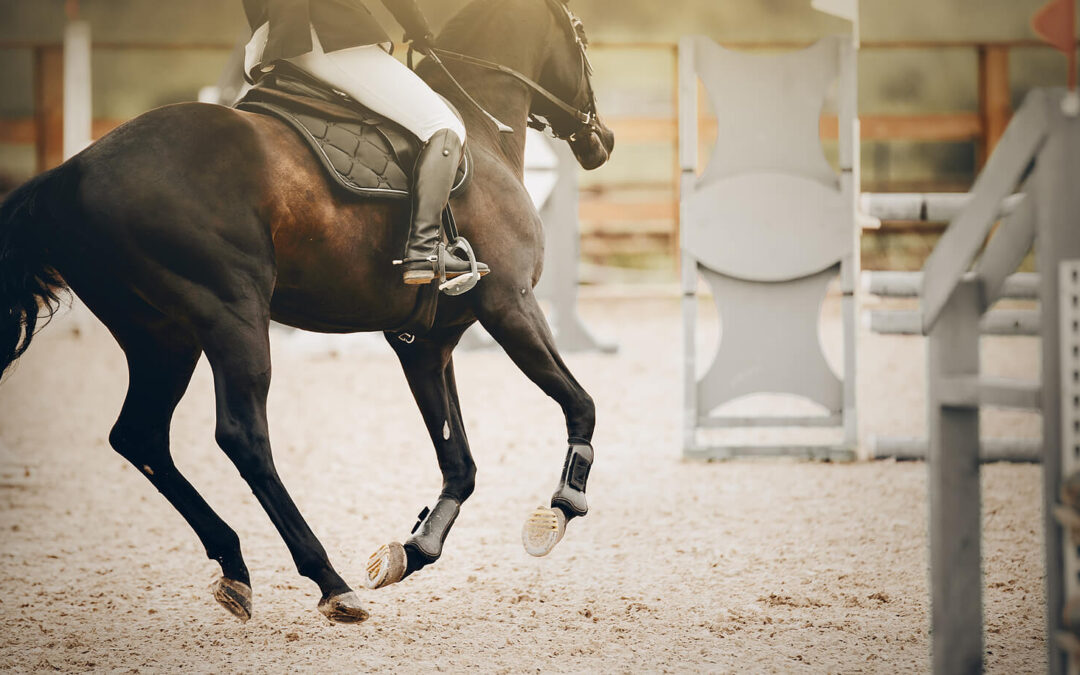
If you’ve been riding for any length of time, you already know this feeling: a great lesson ends and you float out of the barn on a cloud of pure joy. You replay the ride in your head for days. You feel capable, connected, maybe even a little invincible. It’s one of the best feelings in the world.
And then there’s the other kind of lesson.
 You know that one, too. The ride where nothing goes right — your horse spooks at the corner he’s passed a hundred times without blinking, your distances are off, your aids feel muddy, and by the time you dismount, you’re already running the post-mortem. *Why did I do that? Why didn’t he listen? Why did everything fall apart today?* You go home, and the mental chatter follows you — the self-criticism, the replaying, the quiet (or not so quiet) spiral of self-blame.
Here’s what I want to offer you, from both the barn and the therapy room: that hard lesson? It might actually be the more valuable one.
Your Horse Knows What You Brought to the Ring
Horses live entirely in the present moment. They are not thinking about last week’s ride or tomorrow’s show. They are not worried about the budget meeting you had before you drove to the barn, or the argument that’s been sitting in the back of your mind all day. But here’s the thing — they know you brought all of that with you.
Horses are exquisitely sensitive to tension in the body. The tightness in your seat, the subtle brace in your arm, the breath you’ve been holding since you got in the car — they feel it all. And because horses are prey animals wired for survival, when they sense tension and don’t understand the source, they respond with their own: distraction, spookiness, resistance, and not listening. They’re not misbehaving. They’re communicating.
So before you blame the corner, or the footing, or the fact that Mercury is apparently in retrograde again, it’s worth asking a gentler question: *What did I bring into the ring today?*
We as humans spend an enormous amount of energy living anywhere but the present. We live in the future — the anxiety of *what if, what if, what if* — and rarely pause to complete that sentence with something hopeful. What if it goes incredibly well? What if today is actually a breakthrough? We don’t ask ourselves those questions nearly enough. Our horses, bless them, are standing in the present moment waiting for us to join them there.
The Lesson Inside the Bad Lesson
Difficult rides are genuinely good teachers — if we’re willing to be students rather than critics.
 When a lesson doesn’t go well, it’s an invitation to look honestly at how you handle stress. Are you taking a breath and problem-solving? Do you tighten up and push harder? Are you shutting down? Do you blame your horse, your trainer, yourself, the universe? There’s no shame in any of these responses — they’re human. But noticing them matters, because how you show up in the saddle is often a pretty honest reflection of how you show up everywhere else in your life.
A bad ride asks you: *Can you take responsibility for your part without completely dismantling your confidence? Can you acknowledge what didn’t work and still recognize what you did well?* Because there is always something you did well, even in the worst lessons. Sometimes you just have to look a little harder to find it.
Give yourself permission to take a breath. Give yourself permission to have an off day. Horses have them, too — and we extend them far more grace than we extend ourselves.
When the Problem Is the Partnership
Sometimes, though, a hard lesson isn’t about one bad day. Sometimes it points to something bigger: the relationship between horse and rider simply isn’t working.
This is one of the hardest things to sit with, especially if you’ve invested time, money, love, and identity into a particular horse. There’s often a voice that says *I should be able to figure this out. If I were a better rider, a more patient person, a more dedicated horse person, I’d make this work.*
But here’s the truth: a horse can be a wonderful horse and still not be the right horse for you. If the two of you cannot communicate, cannot connect, if every ride is a struggle and you’re both ending up frustrated, you are not failing. You are recognizing something important. And sometimes the most loving, courageous decision you can make — for yourself and for your horse — is to let him go find the rider he can shine with.
That’s not defeat. That’s wisdom.
We face these moments in other areas of life, too. The job that slowly changes until one day you realize you’ve been unhappy for a year and weren’t quite ready to admit it. The friendship that drifts, not because of a falling out, but because people grow in different directions. The realization that something you’ve done for years simply doesn’t fit who you are anymore. Change and adaptation are not signs of failure — they are signs of self-awareness, and that is genuinely something to be proud of.
What If It All Works Out?
So the next time you have a hard lesson, resist the urge to spiral. Go back and look honestly at what happened. Find what you can learn. Notice what you did well. Take a breath. And then ask yourself — not *what if it goes wrong again* — but *what if next time it goes beautifully?*
Because it might. It really might.
Start Working with An Equine Therapist in Virginia
If you’d like to talk through what’s coming up for you — in the saddle or out of it — I’d love to help. Schedule a call, and let’s figure it out together. You can start your therapy journey with Gray Horse Counseling by following these simple steps:
- Contact me to schedule your free consultation
- Read my FAQs to learn more about me
- Start learning lasting lessons!
Other Services Offered with Gray Horse Counseling
Equine-assisted therapy isn’t the only service that I offer at Gray Horse Counseling. I’m happy to offer support with anxiety, self-esteem, and life transitions. Other services I offer include depression treatment, group therapy, EMDR therapy, trauma therapy, clinical supervision, and equine sports therapy. Visit my FAQs, read about me, or contact me today for support!