
TL; DR
Spending time with horses can significantly benefit mental health by fostering a sense of calm, connection, and safety. Horses, being highly sensitive animals, respond to our emotional states, helping individuals with anxiety, depression, and stress reconnect with themselves. Engaging with horses doesn’t require riding; activities like slow grooming, quiet observation, and structured ground-based exercises can promote emotional regulation and self-awareness.
Group experiences with horses can enhance leadership, communication, and trust within teams, offering insights that are often more impactful than traditional feedback. Longer sessions allow for deeper emotional processing and integration, making the experience even more transformative. If you or your organization are seeking a unique, human-centered approach to growth and healing, consider exploring equine therapy in Virginia. It emphasizes presence over performance, offering a gentle path to reconnection and insight.
There is something that happens when you stand next to a horse that is difficult to explain unless you’ve experienced it.
 Your breathing changes, your shoulders drop, and your attention settles into the present moment in a way that feels almost instinctive.
For many people, especially those living with anxiety, depression, chronic stress, or burnout, time with a horse offers something that talk alone sometimes cannot: a felt sense of calm, connection, and safety in the body.
This isn’t about riding skills or doing things “right.” It’s about what horses invite from us—honesty, regulation, and presence.
As a therapist and lifelong equestrian, I’ve seen again and again how powerful this connection can be—not just for individuals, but for groups, teams, and organizations looking for deeper insight, resilience, and emotional regulation.
Why Do Horses Support Mental Health?
Horses are exquisitely sensitive animals. As prey animals, they are wired to notice subtle shifts in energy, body language, and emotional states. They don’t respond to what we *say*—they respond to how we *are*.
This makes them powerful mirrors.
When someone is anxious, a horse notices.
If someone is shut down or disconnected, a horse notices.
When someone softens, regulates, and becomes present, a horse notices that too.
And here’s the important part: horses don’t judge what they notice.
They simply respond.
For people struggling with depression, this can be especially meaningful. Depression often brings a sense of disconnection—from self, from others, from the body. Horses gently invite reconnection without pressure, without expectations, and without the need to explain or perform.
Time with a horse creates opportunities to:
- Regulate the nervous system through rhythm, breath, and presence
- Experience nonverbal connection and attunement
- Build confidence and self-trust through embodied experience
- Practice boundaries, leadership, and emotional awareness in real time
These experiences don’t require words, but they often create insights that stay with people long after the session ends.
Three Ways to Spend Time With Horses for Mental Health
You don’t need to be an experienced rider—or even ride at all—to benefit from time with a horse. Some of the most impactful moments happen on the ground.
Here are three simple, meaningful ways to engage.
1. Slow, Intentional Grooming
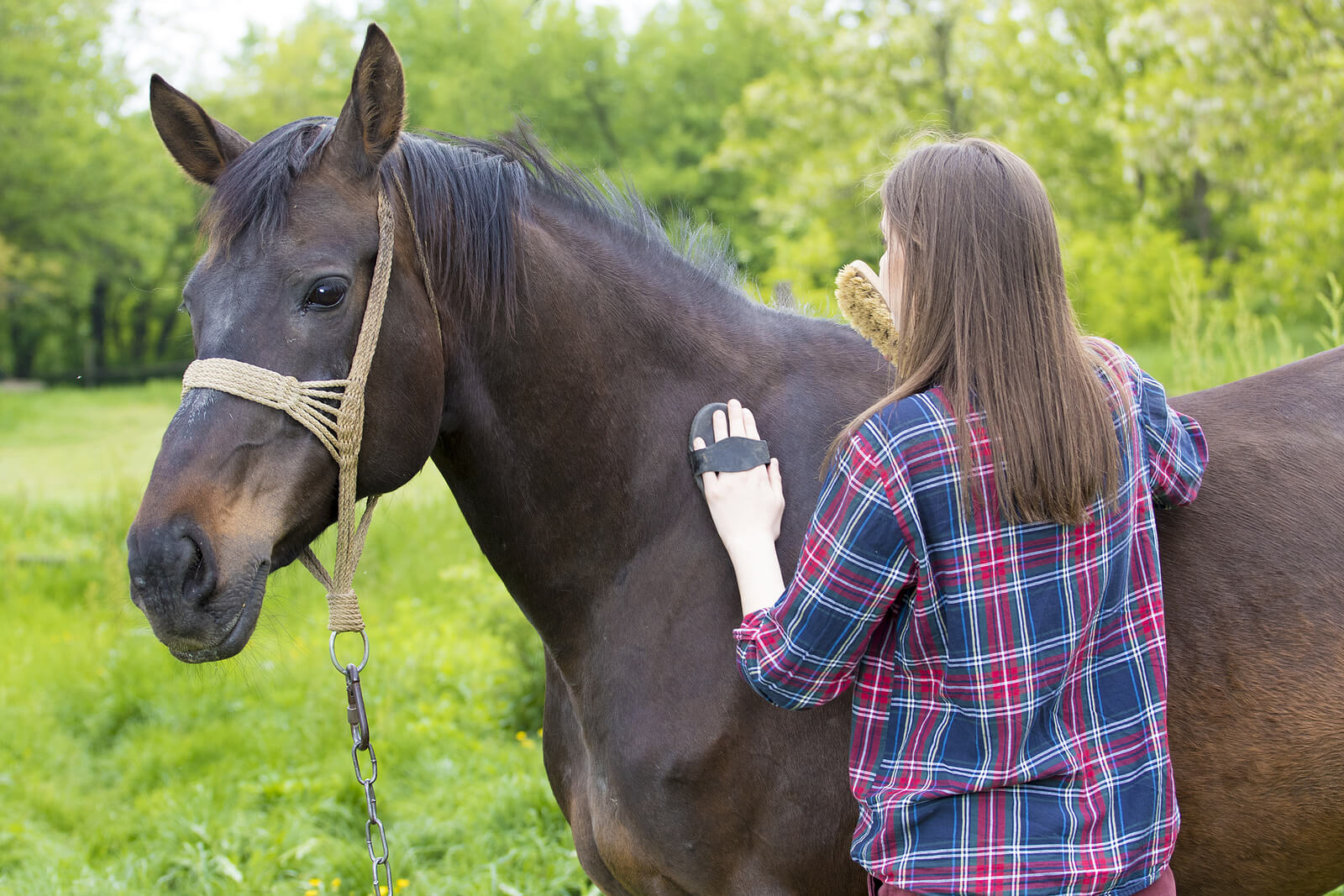
Grooming a horse slowly and intentionally can be profoundly regulating. The repetitive motion, the physical contact, and the requirement to stay present all help calm the nervous system.
This is not about efficiency or doing it “correctly.”
It’s about noticing:
- Your breath
- Your body tension
- The horse’s responses
Horses will often relax as you relax. This feedback loop can help people recognize how their internal state affects their external world—a powerful insight for those navigating anxiety or emotional overwhelm.
2. Standing and Observing Without an Agenda
Sometimes the most healing thing is simply being near a horse without needing to *do* anything.
Standing quietly, observing a horse’s breathing, posture, and movement can help anchor attention in the present moment. For individuals who feel constantly pressured to improve, fix, or perform, this kind of stillness can be deeply restorative.
This is especially helpful for people experiencing depression, who may feel disconnected from their bodies or unsure how to access calm. Horses support mental health by offering a steady, grounded presence that doesn’t demand engagement—but welcomes it when it arises.
3. Guided Ground-Based Activities
Structured, ground-based exercises—such as leading, boundary-setting, or navigating obstacles—can bring emotional patterns into clear focus.
 How do you approach a challenge?
Do you rush, freeze, overthink, or avoid?
How do you respond when the horse doesn’t immediately cooperate?
These moments create insight without judgment. They allow people to practice regulation, communication, and adaptability in a way that feels real—not theoretical.
What Are the Benefits for Groups, Teams, and Organizations?
Individual sessions are powerful. But as an equine therapist in Powhatan, VA, I’ve seen how group experiences with horses can be transformative in a different way.
In group or organizational settings, horses quickly highlight:
- Leadership styles
- Communication patterns
- Trust and boundary dynamics
- Stress responses under pressure
Because horses respond honestly and immediately, teams receive feedback that is difficult to ignore—and often easier to accept than human critique.
Equine-assisted group experiences can support:
- Leadership development
- Burnout prevention
- Team cohesion and trust
- Emotional intelligence and regulation
- Trauma-informed communication practices
These experiences are especially valuable for organizations that want more than surface-level team building. Horses help teams *feel* the difference between control and connection, pressure and presence.
Why Do Longer or Intensive Sessions With Horses Matter?
While brief experiences can be impactful, longer or intensive equine-assisted sessions allow for deeper nervous system shifts.
Extended time with horses gives participants the chance to:
- Move past initial anxiety or self-consciousness
- Settle into authentic presence
- Notice patterns that don’t emerge in shorter interactions
- Practice new responses with support and integration
For individuals navigating depression, trauma, or significant life transitions, longer sessions create space for meaningful regulation and reflection—without rushing the process.
For organizations, intensives allow teams to slow down, step out of habitual roles, and engage in experiential learning that translates back into the workplace.
Depth takes time. Horses understand this intuitively.
A Gentle Invitation From an Equine Therapist in Virginia
 If you’re feeling disconnected, overwhelmed, or stuck—or if your organization is seeking a more grounded, human-centered approach to growth—spending time with horses may offer something different than what you’ve tried before.
Not a quick fix. Not a performance metric. But an experience that speaks directly to the nervous system.
You don’t need to have the right words or need to know what you’re looking for. You simply need the willingness to show up. Contact my Virginia therapy practice to learn more.
Ready to Start Working With Horses? Learn More About Equine Therapy in Richmond
If you’ve felt the pull toward a slower, more grounded approach to healing, equine therapy might be exactly what you’ve been looking for. There’s something quietly transformative about being in the presence of a horse. They don’t judge, they don’t rush, and they respond to exactly what you bring into the arena. That kind of honest, unfiltered connection has a way of opening doors that traditional talk therapy sometimes can’t.
At Gray Horse Counseling, I offer individual equine-assisted therapy sessions, group experiences, and intensive equine-assisted work. Each is designed to meet you where you are and guide you toward lasting mental wellness. Whether you’re navigating anxiety, working through trauma, struggling with self-esteem, or simply feeling disconnected from yourself and others, the horses and I are here to help you find your footing. Sometimes the most meaningful healing doesn’t begin with answers, but with presence. And horses are remarkable teachers of exactly that.
Taking the first step is simpler than you might think:
- Contact me to schedule a consultation and share a little about where you are and what you’re hoping to find. There’s no pressure, just an open conversation.
- Get to know me and the process. Browse my FAQs and learn more about my approach to equine-assisted therapy so you feel informed, comfortable, and ready.
- Begin your journey toward lasting healing with a little help from horses and an experienced equine therapist in Richmond, VA.
Other Services Gray Horse Counseling Offers in Richmond, VA
Equine-assisted therapy has a remarkable way of helping you reconnect with yourself. It allows you to quiet the noise, soften old defenses, and create space for real healing to take root. That growth doesn’t have to end when you leave the arena. It can extend into every corner of your life with the right ongoing support. Beyond equine-assisted therapy, Gray Horse Counseling offers a full spectrum of services to walk alongside you on that journey, including individual therapy, group therapy, equine sports therapy, EMDR therapy, anxiety therapy, depression treatment, life transitions therapy, therapy for self-esteem, and clinical supervision. All available in person in Powhatan and Richmond, VA, or statewide through online therapy. Browse my FAQs and blog, get to know me, and reach out today to take the next step toward the mental health and wholeness you deserve.
About the Author
Courtenay Baber, MS, LPC, is an EAGALA Certified Equine-Assisted Therapist and Licensed Professional Counselor who has witnessed firsthand the profound impact that time with a horse can have on mental health. She owns and operates her own farm, where the steady, non-judgmental presence of horses creates a uniquely safe space for clients to slow down, reconnect, and heal.
With nearly two decades of clinical experience grounded in a B.S. in Psychology, an M.S. in Rehabilitative Counseling, and Level I and II EMDR training, Courtenay brings both heart and clinical depth to every session. Her path to this work began as early as fifth grade, when a school report on mental health ignited a lifelong passion for changing the way people understand and access healing. As a seasoned clinical supervisor and former educator, she is as committed to nurturing the next generation of therapists as she is to showing up fully for every client who steps into the arena.