
TL; DR
Performance anxiety isn’t just about nerves. It often stems from unprocessed memories linked to past experiences. EMDR (Eye Movement Desensitization and Reprocessing) therapy can help by reprocessing these emotional memories, allowing individuals to overcome blocks during high-pressure situations, whether in sports or public speaking. Research shows that EMDR can significantly reduce anxiety and improve self-confidence, often in just a few sessions.
Key insights include:
Performance anxiety can trigger panic and self-doubt, affecting performance.
EMDR targets specific memories and beliefs related to anxiety, promoting a deeper reset than traditional methods.
Studies demonstrate EMDR’s effectiveness in reducing anxiety symptoms and enhancing performance.
If you’re struggling with performance anxiety, consider exploring EMDR therapy to reprocess those old stories and regain your confidence!
Let’s be honest—performance anxiety isn’t always about fear of trauma.
 Sometimes it’s about fear of messing up. Of blanking out. Of freezing under pressure and losing trust in yourself at the very moment you’re supposed to rise to the occasion.
Whether you’re stepping into the competition ring or standing in front of a crowd, performance anxiety can feel paralyzing. You know your material. You’ve trained for this. But suddenly your body says no, and your mind becomes a swirling mess of what-ifs.
That’s where EMDR therapy comes in. While most people associate Eye Movement Desensitization and Reprocessing (EMDR) with trauma therapy, mounting research and real-world experience show that it can also be a game-changer for performance anxiety.
What is the Link Between Performance Anxiety and Past Experience?
Performance anxiety isn’t just a confidence issue—it’s often a processing issue. When a past event (a fall, a failure, public embarrassment) is stored maladaptively in the brain, similar situations in the present can trigger a threat response.
That response looks like panic. Tension. Nausea. Shaking. Self-doubt. For athletes, it can mean a mistimed jump or an incomplete pass. For professionals, it might mean forgetting your speech or avoiding presentations entirely.
Research shows that these “performance blocks” are often rooted in unresolved emotional memory. In one compelling study, a professional golfer experienced involuntary spasms and anxiety while putting—symptoms that resolved after EMDR therapy reprocessed life events contributing to the block (Bennett et al., 2017).
In other words, it wasn’t just about nerves. It was about unprocessed experiences triggering the brain’s fight-or-flight response in real time.
EMDR: A Deeper Reset Than Mindset Work Alone
Unlike talk therapy or mindset coaching, EMDR works at the level of the nervous system. Through bilateral stimulation (like eye movements or tapping), it helps the brain reprocess stored emotional memories and reorganize them into a more adaptive framework.
One study involving athletes with PTSD-like symptoms after sports injuries found that even a single session of EMDR significantly reduced anxiety and improved self-confidence (Reynoso-Sánchez & Hoyos-Flores, 2023). Heart rate variability data confirmed this change wasn’t just subjective—it showed actual nervous system regulation during and after therapy.
Imagine no longer bracing yourself before every ride, every speech, or every spotlight moment. An EMDR therapist doesn’t teach you to cope with anxiety. It helps your brain learn that there’s nothing to fear in the first place.
Performance Blocks: When “Try Harder” Doesn’t Work
In equestrian sports, I see this all the time: talented riders suddenly lose their ability to trust themselves and their horse. The tension becomes visible in their seat, their hands, their breath.
Performance blocks like this are described in the literature as “yips,” “lost move syndrome,” or “freezing.” These aren’t just habits—they are mental blocks often triggered by emotion-laden memories stored in the nervous system (Bennett et al., 2017).
One athlete in the research had suffered for over a decade, despite trying every technique change and coaching method. EMDR, paired with graded exposure, helped him reprocess the root of the problem—and regain his ability to perform. He wasn’t broken. He just needed a better tool.
EMDR and Public Speaking: More Than Just Stage Fright
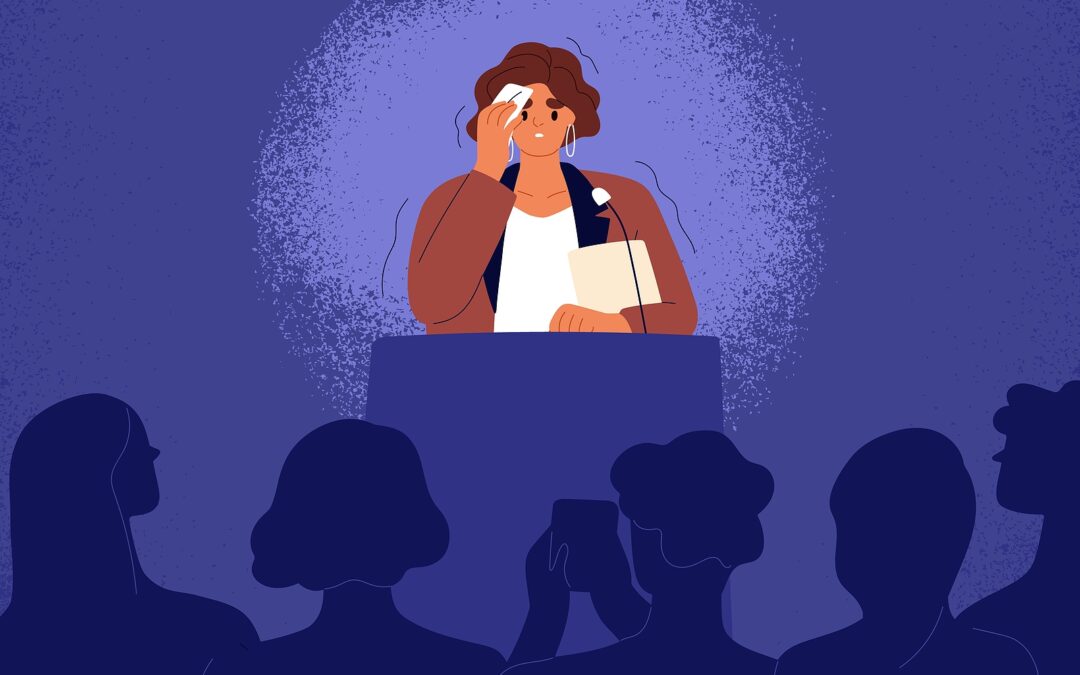
 Performance anxiety doesn’t just live in the ring or on the field—it thrives in boardrooms and classrooms too. One case study followed a student whose intense fear of public speaking made him question his career choice. After just three EMDR sessions, his anxiety dropped from the 98th to the 55th percentile on the State-Trait Anxiety Inventory (Barker & Barker, 2007).
Twelve months later, he was successfully delivering presentations in a management role—without fear. That’s what unfreezing looks like.
Presentation anxiety often stems from earlier experiences of embarrassment, shaming, or being told to “just get over it.” But the brain doesn’t work that way. It stores the emotional memory, then brings it forward when the stakes are high. EMDR can help reprocess those earlier events and install positive belief templates like “I can handle this,” or “I have a voice worth hearing.”
But Is EMDR Really Effective for Anxiety?
Yes—and the science is catching up. A 2019 review of randomized controlled trials found that EMDR therapy reduced symptoms across a range of anxiety disorders, including panic and phobic disorders (Faretta & Dal Farra, 2019). While EMDR isn’t currently the first-line treatment in many clinical guidelines, these studies show it holds its own next to CBT—and in some cases, works faster with fewer sessions.
It’s particularly promising when anxiety has a somatic or trauma-linked component—something that traditional talk therapy can struggle to resolve. That’s why it’s such a powerful tool for performance blocks: it addresses the source, not just the surface.
What Do EMDR Sessions for Performance Anxiety Look Like?
EMDR for performance anxiety doesn’t look that different from trauma work—but the targets are specific to the individual’s performance history. Identify the targets:
- The most disturbing past memory connected to the anxiety (e.g., falling off in the show ring, feeling humiliated during a team talk, missing the shot on the court or the field)
- The current trigger (e.g., entering the ring, seeing an audience)
- The negative belief (e.g., “I’ll fail again,” “I’m not good enough”)
- The desired belief (e.g., “I can handle pressure,” “I’m capable and calm”)
Then we process those experiences—often with surprisingly rapid results. Many clients begin noticing a shift in just a few sessions.
A Final Word From an EMDR and Equine Therapist in Richmond, VA
 Performance anxiety doesn’t mean you’re weak. It doesn’t mean you haven’t trained hard enough or visualized the right way. It often means there’s an old story playing in the background—one your brain hasn’t finished processing. EMDR with Gray Horse Counseling can help you close that loop. It helps you stop bracing and start trusting yourself, your body, and your ability to perform under pressure. So whether you’re in the saddle or on the stage, remember: you don’t need to push through performance anxiety. You can process it.
Ready to Overcome Performance Anxiety? EMDR Therapy in Richmond Can Help
If anxiety keeps hijacking your performance, it’s time to try something different. EMDR therapy doesn’t just help you push through. It helps you reprocess and release the root of your performance blocks. If you are interested in the transformation that can come from EMDR therapy, please schedule a consultation. You can start your first EMDR therapy session with Gray Horse Counseling by following these simple steps:
- Book your free consultation — Reach out to connect with me and explore whether EMDR is the right fit for your journey.
- Get to know me and the process — Browse my FAQs and learn more about my equine-informed therapy approach so you feel confident and prepared.
- Begin performing as your truest self — Work toward lasting freedom from performance anxiety with an EMDR therapist in Richmond, VA.
Other Services Gray Horse Counseling Provides in Virginia
Performance anxiety can touch every corner of your life, from the stage to the everyday moments that matter most. Through EMDR therapy, you can not only quiet the fear that shadows your performance, but also build the confidence and clarity to show up fully in every area of your life. Gray Horse Counseling offers a wide range of services to meet you wherever you are on that journey, including individual therapy and group therapy. We offer specialized equine-assisted therapy, equine sport therapy, as well as counseling for trauma, anxiety, depression, self-esteem, and life transitions — available in person in Richmond, VA, or statewide via online therapy. Browse my blog and FAQs, learn more about me, and reach out today to take the first step toward the life you deserve.
About the Author
Courtenay Baber, MS, LPC, is a Licensed Professional Counselor with nearly two decades of experience whose passion for healing is rooted in both deep compassion and a lifelong love of animals. Sparked by a fifth-grade report that revealed how misunderstood mental health truly was, Courtenay has built a career dedicated to creating real, lasting change for her clients. With a B.S. in Psychology and an M.S. in Rehabilitative Counseling, she brings a strong clinical foundation to her work — including Level I and II EMDR training, which equips her to help clients reprocess the deep-rooted experiences driving performance anxiety and other challenges. She is also EAGALA Certified in Equine-Assisted Therapy, and runs her own farm where she integrates the grounding, ever-present nature of horses into the healing process — a powerful complement to the trauma-focused work of EMDR. A seasoned clinical supervisor and former educator, Courtenay is as invested in growing the next generation of therapists as she is in rooting wholeheartedly for every client who walks through her door.
References
Barker, R. T., & Barker, S. B. (2007). The use of EMDR in reducing presentation anxiety: A case study. Journal of EMDR Practice and Research, 1(2), 100–108.
Bennett, J., Bickley, J., Vernon, T., Olusoga, P., & Maynard, I. (2017). Preliminary evidence for the treatment of performance blocks in sport: The efficacy of EMDR with graded exposure. Journal of EMDR Practice and Research, 11(2), 96–110.
Faretta, E., & Dal Farra, M. (2019). Efficacy of EMDR therapy for anxiety disorders. Journal of EMDR Practice and Research, 13(4), 325–337.
Reynoso-Sánchez, L. F., & Hoyos-Flores, J. R. (2023). A single-session eye movement desensitization and reprocessing (EMDR) therapy reduces anxiety and improves self-confidence in athletes with post-traumatic stress associated with injury. International Journal of Sport Studies for Health, 5(2), e134823.